28 Aug Agronomy Update – August 28
Hello everyone,
Firstly, a big thank you to everyone who attended any of our AIM BBQs this week. We had a strong attendance at each event, and I trust no one left hungry. Some folks I would like to thank include:
- Our generous hosts: Sweet Farms, Bridgeview Acres, and Spud Isle Farms. We appreciate you taking the time to help us host these events at a very busy time of year.
- Riley Chappell with the PEI Federation of Agriculture, for assisting with event setup
- Scott Howatt for his mastery on the BBQ and keeping everyone fed
- Amanda Pineau for assisting Scott with procurement for the BBQs
- Christine Parsons, for helping me dig 10-foot strips for each event as well as event setup
- Jennifer MacLeod and Jennifer Klaus with AAFC, who helped us with digging some preview strips in Living Lab trials, along with a bigger crew from AAFC assisting me with other trial sampling.
- Farmers for Climate Solutions, for helping to sponsor the events in partnership with Genesis Crop Systems and the PEI Federation of Agriculture.
Chrstine and I were in quite a few fields this week digging samples for the BBQs, and we were very pleased with what we saw. Most fields are still quite green and are steadily bulking. We had a number of 10-foot strips in the 250-300 cwt/ac range…for the last week of August, that is quite encouraging. Generally, fields look pretty healthy and have enough moisture now to set up for a couple of crucial weeks of tuber bulking as we transition into September.
A few things I’ve been hearing and seeing:
- Starting to see some Bortrytis (grey mold) in a number of fields. This is further confirmed by the large Bortrytis spore counts we are starting to see from Air Spore (below). I would recommend switching from mancozeb to chlorothalonil for contact fungicides for the next couple of weeks, particular for susceptible varieties. Other than Bravo/Echo, other chemistries with grey mold on the label are Vertisan (control) and Miravis Duo (suppression).
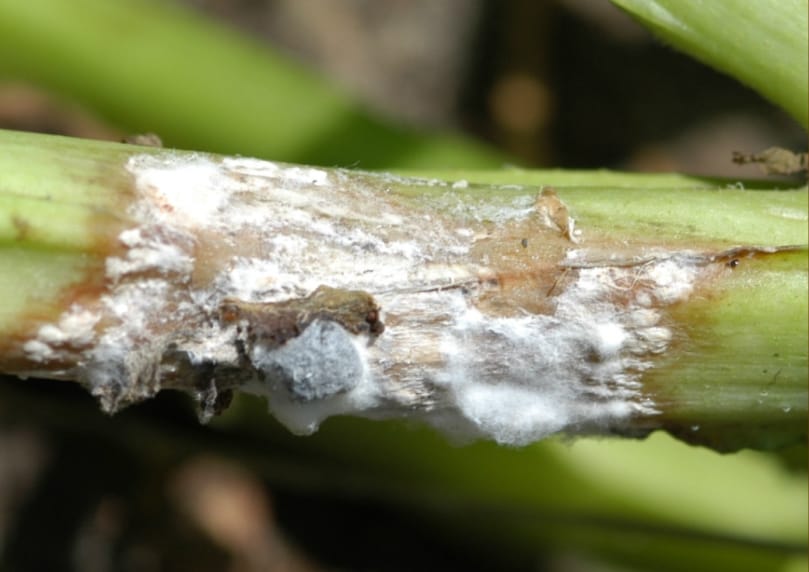
- Also starting to see/hear about some white mold showing up in some fields after the last 10 days of wet weather. In one field we were in on Wednesday, we saw a large number of the sclerotinia mushrooms (photo attached) on the surface of the soil that serve as the source for white mold infections. Chemistries that are labelled for control of white mold include:
- Allegro 500F (fluazinam)
- Downforce AG (fluazinam)
- Acapela (picoxystrobin)
- Vantana (fluazinam)
- Propulse (prothioconazole + fluopyram)
- Sercadis (fluxapyroxad)
- Luna Tranquility (fluopyram + pyrimethanil)
- A number of growers are starting to terminate forages and get land prepared for fall tillage/cover crops. I know that several farms are looking at fall cover crop options that will help control wireworms. A couple things to consider:
- The sooner you can plant brown mustard or buckwheat, the more root mass can be achieved, which is what the wireworms feed on. It is chemicals in the roots that is ingested by the wireworms that interrupts their growth and causes death.
- I have heard that some growers are looking at tillage radish for wireworm control. I have not seen any local research that shows that tillage radish or oilseed radish is effective at killing wireworms. Most brassica species other than mustards have had much of the beneficial chemical (glucosinolates) that kill wireworms bred out of them. If you have a known issue with wireworm, use of brown mustard or buckwheat as a fall cover crop is recommended.
- Some growers have experienced issues with slow or incomplete kill on alfalfa with glyphosate (Round-Up). With a very vigorous, multi-year stand of alfalfa, termination can sometimes be tricky. Hopefully the more favorable weather conditions this year will prevent fewer issues. A couple of suggestions:
- For the most effective termination, glyphosate should be sprayed during the day under full sunshine, not early morning or late evening.
- Ensure that you have a recommended adjuvant tank-mixed with your glyphosate.
- For heavy stands of alfalfa, use of the full label rate is recommended.
- If you have followed the above recommendations in previous years and have still had issues with uneven termination, consider a tank-mix with 2,4-D.
Air Spore:
- Bortrytis (grey mold) spore counts are at their highest levels of the season so far. Adjusting fungicide programs to protect against grey mold is recommended.
- Early blight spore counts remain high in Central PEI. If you are seeing significant pressure in your fields from either early blight or brown spot, fungicide application as the canopy is starting to settle down may be warranted. However, this tends to be very variety specific, as some varieties (ie. Targhee, Ranger Russet) are more susceptible to Alternaria than others.
- No late blight spores have been detected in PEI or NB. I have not yet heard about any foliar late blight detected in Eastern Canada or the Northeast US.
| Early Blight | Brown Spot | Grey Mold | ||||
| (A. solani) | (A. alternata) | (Bortrytis cinerea) | ||||
| Region | Aug 24 | Aug 26 | Aug 24 | Aug 26 | Aug 24 | Aug 26 |
| West Prince | 0 | 4 | 5 | 4 | 63 | 59 |
| East Prince | 247 | 116 | 84 | 17 | 1058 | 966 |
| Queens | 0 | 338 | 0 | 9 | 18 | 6133 |
| Kings | 0 | 36 | 0 | 13 | 341 | 153 |
Aphid Alert:
- Aphid numbers remain quite low across the province this week and last.
- A number of early generation seed fields have already been top-killed. More will follow in the next 7-10 days.
| Date | Region | Number of Samples | Green Peach Aphid | Potato Aphid | Buckthorn Aphid | Foxglove Aphid | Bird Cherry-Oat Aphid | Other Aphid | Tarnished Plant Bug | Total Aphids | Average Aphids per Sample |
| 24-Aug-26 | WEST PRINCE | 15 | 0 | 0 | 1 | 0 | 0 | 6 | 0 | 7 | 0.47 |
| EAST PRINCE | 10 | 0 | 0 | 12 | 0 | 0 | 12 | 8 | 24 | 2.40 | |
| QUEENS | 9 | 0 | 1 | 0 | 0 | 0 | 3 | 0 | 4 | 0.44 | |
| KINGS | 3 | 0 | 0 | 2 | 0 | 0 | 1 | 0 | 3 | 1.00 | |
| Total | 37 | 0 | 1 | 15 | 0 | 0 | 22 | 8 | 38 | 1.03 | |
| Week Ending | Region | Number of Samples | Green Peach Aphid | Potato Aphid | Buckthorn Aphid | Foxglove Aphid | Bird Cherry-Oat Aphid | Other Aphid | Tarnished Plant Bug | Total Aphids | Average Aphids per Sample |
| 22-Aug-26 | WEST PRINCE | 25 | 0 | 2 | 3 | 0 | 0 | 10 | 5 | 15 | 0.60 |
| EAST PRINCE | 20 | 1 | 0 | 17 | 0 | 0 | 21 | 10 | 39 | 1.95 | |
| QUEENS | 20 | 0 | 0 | 7 | 0 | 0 | 17 | 1 | 24 | 1.20 | |
| KINGS | 6 | 0 | 0 | 6 | 0 | 0 | 4 | 0 | 10 | 1.67 | |
| Total | 71 | 1 | 2 | 33 | 0 | 0 | 52 | 16 | 88 | 1.24 | |
Have a great weekend, everyone.
Ryan